On Art 1968-91 |
Painting I. 1966-70 |
How It All Started 1968-71 |
Signs [Modules] 1971-79
Conceptual works 1973-82 |
The Ego Problem 1973-76 |
Objectworks 1974-93
Painting II. 1984-89 |
Sound Sculptures 1974-91 |
Performance 1972-92
Technical Images 1974-92 |
Space Works 1970-93 |
Network/Institutions 1970-93
1973-1975
EXISTENCE, ACTION, NOTHINGNESS
1973
Packaged Exhibition (Missing Works)
The exhibit would have consisted of the sign-works completed between 1970 and 1973. [invitation]
The “Lektorátus” (for all practical purposes a board of censors) accepted the material-in the category of works to be exhibited at the artist's expense-but by the time I arrived with a van to transfer the material from the Board's offices to the Technical University, Éva Barta, the then chairman of the Board, overruled the Board, and vetoed the exhibition of about two-thirds of the material. Banned, for instance, was Summer from the Four Seasons series
(a hint, perhaps, at my activities at Balatonboglár, which official circles were known to frown upon), and single pieces from several other series.
It was obvious that what was left could not be exhibited arranged as I had originally planned. We left the Castle, and by the time we reached Moscow Square, I had an idea: I would arrange the exhibits according to my original plan, and would display the banned works boxed or wrapped in paper, i. e. packaged.
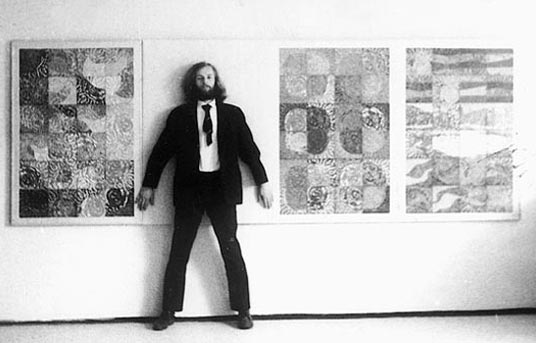
That same day, I designed a new invitation: I photographed myself as I stand, arms flung wide, in front of the packaged Summer of the Four Seasons series. That night I made fifty copies, and mailed them to critics and to the leaders of the art world.
The “Packaged Exhibition” was an exhibition of “Missing Works”. The packaged pictures
became my first “Trans-functioned Objects”, and the “Packaged Exhibit” the first of my works of “Scandal Art”.
CONCEPTUAL ART, BEHAVIORAL ART, ACTION
1973 (?)
A Documentation of Existence
(texts for a table-a plan)
1. My existence is documented by the existence
of others.
We certify our existence with each other's existence.
2. I certify your existence with my existence, you certify my existence with your existence.
3. Existence undermines consciousness.
Consciousness changes existence.
4. (If consciousness undermines existence, then)
this table reads: “Existence undermines consciousness”
1973(?), early 1974
A text created by superimposing one text on another.
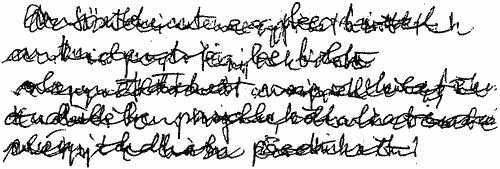
February 5, 1974
Real, but not visible
Visible but unreal
(Portrait of God)
György Galántai,
member of the Art Foundation of the Hungarian People's Republic, is
VISIBLE
where he is not to be seen.
Comment: A visible object that corresponds to an invisible one is capable of visually conveying the substance of the latter object only relatively speaking, thus the essence of any given reality lies in the simultaneous perception of the visible and the invisible.
A work of art is an object created for sense perception, thus we must consider every object that makes the world of phenomena perceptible to man to be a work of art.
Note
The major task in creating an object is to devote every effort humanly possible to attempt, even at the unconscious level, to approximate with all one's senses the dimension in which all objects that exist independently of one are interconnected. Presumably, this will get one closer to understanding them.
February 6, 1974
Note
Character is independent of knowledge and intellectual capacity.
Plan: Variable systems for consumption (For example bread and butter with salt, sugar, etc.).
What is characteristic of my work is not a unity of style, but a unity of behavior and intellectual attitude.
What characterizes a certain period is not style, but a way of thinking.
June 17, 1974
Theme: A variety of visual signs whose meaning can be changed verbally.
(Task: to investigate the verbal - purely visual correspondence.)
August 1974
Theme: SELF-MANIPULATION
I discovered life, not the chapel.
Theme: nothing, something, the wholly and half-something, the wholly and half-nothing.
Theme: The by-products of a patient life. (A picture composed of receipts for books I had to sell.)
November, 1974.
TRUE or FALSE ?
The Szentendre action (plan)
Business card I. Text (on two sides of the card):
a. Don't believe me, ascertain the truth.
b. Believe me, whatever I tell you is not true.
(The two sides of the card.)
Business card II. Text:
a. The whole thing was just a game.
b. Don't you believe it's a game you're taking part in.
1974
The key to life-art
The key to art-life
January 2, 1975.
Attitude is the model of action in art.
March 3, 1975
“Action-piece”
The graphic equivalents of everyday actions; washing oneself, for example, washing one's face.
My face is covered with paper, and I wash my face with hands full of paint. The end result is graphics (a sequence of minimal actions).
Theme: Red blackboard and other monochromes (plan).
Situation art (the art of resistance-the generation of counter-values).
(Conceptual minimum, minimal actions, semblances of action, the mutable meaning of situations).
April 2, 1975
What is war? To destroy a great deal of human effort with a great deal of human effort.
October 18, 1975
“Nothing”: a convention (note)
There's only something and the lack of something (the lack of something is another something without substance).
“Nothing” is a fictitious something.
Something is always concrete, and is in some actual place.
“Nothing”, as an anti-something, can be apprehended as the non-existence of something in another something.
Action exists only in a something.
Action realized in the absence-of-something sphere is the illusion of action.
Nothing but the thought of action is pseudo-action.
The feigning of action is an action substitute.
“Something” can take place only in an infinite series of somethings.
Action is a vehicle in the something sphere,
a something which allows you to create new somethings.
1976(?)
Plan:
Copy together different paintings,
drawings and styles so that they form
a new picture (in twenty different variants);
for example, new written characters, etc.
August, 1977
The object of work is work itself.
I produce something which is itself, and at the same time also a documentation of its production.
I do something which my concentration and immediate awareness brings to an end.
In the process of termination, I objectify my action. The object of the action is the action itself. Action is directed to action itself, in order to answer certain questions about existence.
1977
Plan
Reality and Man: Descriptions of reality: On the one hand, active man, on the other, the external factors influencing him.
1977
Deficit graphics (I only sign the passe-partout)
1. note on graphics: there are no graphics
2. conventions with regard to the passe-partout: number of centimeters, the edge of the sheet, etc.
3. the graphics continue on the passe-partout, but there is no picture in the area it surrounds.
1977-1979
Name of the person placing the ad: György Galántai
Address: 1023 Budapest, Frankel Leó út 68/B
Please write your ad legibly!
Please have your personal identification card ready. AU-V 874732
Magyar Nemzet
in the Sunday issue
Text of the ad:
FOR ARTISTIC PURPOSES
I'LL TAKE ANYTHING
AS MY GREATEST SHORTCOMING
PHONE: 162-659
TODAY ONLY
(it never actually materialized, for they wouldn't print the ad)
1979
Thoughts multiply by division.
-The object of thought: the opportunities open to thought through action.
-The object of art: the documentation of action.
1979
I don't finish anything, I only pretend that it's done.
An exhibit which does not have to be set up.
At a very bad, inaccessible location, with very elegant advertising. (Nobody comes, for nobody can find the place.)
1979
Ideas
Theme: the creative process itself
1. The artist, who wants something but does nothing.
2. The non-artist, who doesn't want anything but does something-the same thing.
Means available to the invisible artist working with the greatest apparatus:
1. He maintains an office on government money.
2. He uses all public offices to his own advantage at will.
3. He maintains substandard galleries, holds exhibitions, and publishes catalogues in great quantities.
His methods:
1. Whispering campaign.
2. Hot line.
3. Hoax, deception, bluff.
4. Open and indirect propaganda.
80/84?
There is something that has not passed, has never been a fad; it's been around for a while but we never got it, and so it's still around.(What is it?)
I document impossible situations as if they were true, real things.
1980
Rubber stamp design (slogan)
I hide by becoming manifold.
Telegram-drawing
(In lieu of a drawing)
There's no need to invent anything; all one needs to do is to understand and interpret what is.
Plan
(Hommage à Fred Forest)
The boundary line of Hungary is for sale for artistic purpose.
May be viewed at the graphics exhibition at the Pécs Gallery.
1981
Posters for non-existent exhibitions.
Define the uncertain with insane accuracy.
Activity as situation-documentation.
Activity as the documentation of putative activity.
Activity as the documentation of impotence.
Minimal inactivity model.
Conceptual counter-artistic object.
1982
The space that functioned as the “Drawing '82” exhibition trans-functioned into a drawing.
Technique: Space, movement, time.
Basement arrangement trans-functioned into a drawing.
The movement of the people in this room is my drawing.
Note: Drawing always refers to something.
It is the plan, the sketch of a real, perceptible thing.
Thus the work of art is really the thing it refers to; the drawing is a work of art only in the context of the relationship.
If you see my drawing, then it's your drawing.
Note: The drawing's connection to its subject is realized by the viewer in the act of perception.
Drawing, in itself, is meaningless. Viewers trans-function drawings and make them manifold. The only thing that can legitimate a drawing is when someone identifies with it. Identification is more important than the work of art. Whatever we can identify with becomes a work of art, and what we cannot identify with becomes a scribble.
On Art 1968-91 |
Painting I. 1966-70 |
How It All Started 1968-71 |
Signs [Modules] 1971-79
Conceptual works 1973-82 |
The Ego Problem 1973-76 |
Objectworks 1974-93
Painting II. 1984-89 |
Sound Sculptures 1974-91 |
Performance 1972-92
Technical Images 1974-92 |
Space Works 1970-93 |
Network/Institutions 1970-93