On Art 1968-91 |
Painting I. 1966-70 |
How It All Started 1968-71 |
Signs [Modules] 1971-79
Conceptual works 1973-82 |
The Ego Problem 1973-76 |
Objectworks 1974-93
Painting II. 1984-89 |
Sound Sculptures 1974-91 |
Performance 1972-92
Technical Images 1974-92 |
Space Works 1970-93 |
Network/Institutions 1970-93
November 1974
Tube graphics
One should create objects that are sculptures, graphics and paintings all at the same time: in other words, visual objects whose main purpose is visually effective communication.
1974 (?)
Phenomena continuously thrive and continuously waste away.
Objects gain meaning as they are stripped of their function. Meaning becomes their function, and they become objects of art. (Portrait of God)
“Trans-functioning” is none other than movement: we add, take away or substitute functions. Movement continually trans-functions everything.
We never terminate anything, only change its function.
The new = trans-functioned
Trans-functioning is a qualitative move, producing either a higher or lower quality.
The measure of the quality of the effected trans-functioning is the degree to which there is a gain or a loss of information value.
TRANS-FUNCTIONED OBJECTS
In theory, anything can be a trans-functioned object if perceived as such. Everything can be perceived also as its opposite, at will.
Trans-functioned objects retain their original meaning or characteristics and become objects of art through reclassification. In general, they lose their prior function, exceptions being the direct or indirect objects which either retain or regain their prior or related functions.
The essence of trans-functioning is the recharging of objects with new energy.
The new information also contains the original meaning, which helps in the object's interpretation.
Types:
1. Static objects building on emotion (direct objects)
2. Stable mobiles (structured and specified in every detail)
3. Mobiles (objects requiring action, interference)
4. Complex objects with several strata of functions (indirect objects).
Structurally, they are similar to the formulas describing the methods of sign-building (sequences, simultaneous signs, etc.).
Material used
1. Scrap and junk
2. Used articles or parts thereof
3. Supplementary semi-finished materials
4. Copies: things “transliterated” as material (e.g. a sole)
Material - structure - character
I. Junk and Scrap
1. junk - as scrap (mechanically or manually produced)
2. junk - as semi-finished materials
3. junk - as used objects
II. The relations of used equipment
mechanical, electronic, spring action, water, light, sound etc.
Object - meaning - title
Message: practical, philosophical, psychological
The title:
1. Always follows the meaning of the used junk (or found object), or refers to its use.
2. The most important reason for verbal formulation is to lift the object from the sphere of sense perception, i.e., experience, to the level of cognition.
3. The fact that we take for granted that signs operate at the level of both a primary and a secondary meaning makes us receptive to their being “commandeered” by art.
1974
Graphics as a way of advertising sculpture
(another trans-functioning)
I. Direct objects: The flower context
Primary reference to the three Ts of cultural policy: Támogatott (tended/encouraged), Türt (tolerated), Tiltott (taboo)
1. Flower in water.
2. Flower in a mug, no water.
3. Water in the mug, flower wilting next to it.
4. Verbal interpretation of the flower (from N. A.'s book)
II. Prints of trans-functioned objects (1975).
(The work is an ad for another work)
Graphics of the first iron sculptures, which could not be exhibited, may be reproduced and circulated as posters or, later, as stamps.
Paintings as a succession of monochrome colors from black through gray to white (painting replacing a painting).
The place of the exhibit is a place of meditation; it functions through the exhibited “changeling” works of art. “Two-fold Compensation“ (1975)
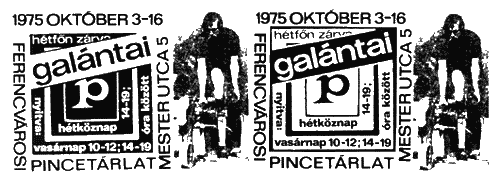
The invitation to it is also part of the exhibition: it solicits visitors with a halved counter-value stamp of half (monetary) value. The city flooded with little stickers (pasted and hand-distributed), something which was unusual at the time (the stickers featuring a photo of Galántai, pushing his sculpture Counter-Stepper mounted on wheels).
Other works
Main Road - Private Property board(Balatonboglár, 1973)
A work of art to be used. Trans-functioned road sign. A different interpretation of road.
(The board says: Private Property).
Contradiction between the visual and the verbal information.
The Main-Road-Sign Group (1975)
In its original meaning, repeating the sign makes no sense.
It is by repetition that the meaning is lifted into the sphere of art. (A multitude of main roads is needed.) An East-European problem.
The Main-Road-Sign Group represents a yearning for something that is not, while the Main Road - Private Property sign describes the acceptance of a situation.
Other forms of repetition
200% Pickaxe (1979) and Counter-Shovel (1975) (egymást eszköztelenítő eszközök)
Unique forms of trans-functioning:
While the repetition of the implements suggests collectivism, the original sense of the tools disappears in the context. (Collective inertia.)
Repetition is natural, objectification is absurd.
The contraposition can be seen as a documentation of the situation.
MAKING THE OBJECT DISAPPEAR
(the object symbolizes the essence)
Double Approach to Reality (Ship, Cap) 1977
In two sets of contradictory graphic information, the object is present invisibly.
1 surface transformation + 1 negative imprint
THE SYSTEM OF FLEXIBLE POSSIBILITIES
The method
1. Two systems, one undermining the other.
2. Two systems, one supplementing the other.
Inversions:
2. Object that continues to exist. Leads to
two contradictory (unlike) systems (two imprints).
1. Object that ceases to exist. Leads to two contradictory systems. (One is the imprint of the object, the other imprint is created by the disappearance of the object.)
UNIQUE OBJECTIFICATIONS OF PRACTICE
The object involved in the action (imprint).
Objectifications of the action (print).
1977
Objects: The importance lies not in the objects, but in the thoughts they represent.
'Medium Cultivator'
This time I said: steel, but later I will say: light, and then I will make works of light.
1977
“AXIOMS”
I subject real relationships to real but different demands, and arrive at reality through real transposition.
I subject real relationships to real but different (new) demands. The resulting different (new) correlation must be real.
A new, real correlation emerges from the interaction of a real, concrete relationship
and a concrete, new demand. The new correlation will prove seminal (presumably).
A further step: “Book Objects“
Here, the object and the prints were shown side by side. The printing was done on a perpendicular plain; the form appeared as a positive, and, once again, we got two composition with no resemblance to each other.
At the opening of the Book Objects exhibition, Anna Banana's audio performance-the reading of the Hungarian text of the opening remarks-duplicated the divergence in information content between object and projection.
February 27, 1979
SUPPLEMENT TO THE INTERPRETATION OF “BOOK OBJECTS”
I. Breaking down objects to their basic components with the help of verbal identification.
Identification: Fusion of a series of level copper-plate ends with high-tension electric fuse [security] parts.
II. An attempt to identify objects on the basis of formal conventions:
Diary, Book opening backwards, Best seller, Open file, Core of the book.
1989
Note
1. One should accept as true only forms which have already been tried in real life.
2. These forms automatically find a way to relate to each other, and, thus, are capable
of creating real messages (of becoming informed).
3. It is essential that the person effecting the object relationships be morally pure and intellectually impervious to outside influences, for
4. whatever we do in our short lifetime, our primary purpose must be to hold fast to our resolve to
understand the complex correlations of existence.
(Democratic Triangle, 1985) (Plaques, 1985) (Piano of silence, 1988)
About the sole
At the time, I had nothing to hang on to (of objects, not people) but a pair of size 42 sandals (available in the retail trade), which represented the minority with size 42 feet.
1. The sole of a size 42 foot as the metaphor for an invisible minority. (METAFLORA)
2. The forty-twoers' sense of being a minority. (!)
3. The size 42-status officially identified.
4. The other connections (even more official: machine parts i.e., parts of the “mechanism”) serve to reinforce this identification
(Liberty-Prison, 1979)
The sole (footprint) symbolizes walking. Taking steps: getting around, for, luckily, one doesn't always use an automobile. In Latin, and Latin-based languages, getting around means: communication. Communication, therefore, is getting around as well as conveying information.
In 1975, when I first used the footprint motif, I hadn't formulated this idea so clearly; I started using it instinctively, sensing some magic quality in it. The footprint is important to me because, trivial correlation though it is, it allows me to say a great many things; and, the very simplicity of its form makes it perfect for subjection to a variety of modifications. The array of meanings inherent in the footprint-communication, moving ahead, marking time but not going anywhere, etc.-are all highly relevant in Hungary, and in fact the world over, today.
On Art 1968-91 |
Painting I. 1966-70 |
How It All Started 1968-71 |
Signs [Modules] 1971-79
Conceptual works 1973-82 |
The Ego Problem 1973-76 |
Objectworks 1974-93
Painting II. 1984-89 |
Sound Sculptures 1974-91 |
Performance 1972-92
Technical Images 1974-92 |
Space Works 1970-93 |
Network/Institutions 1970-93