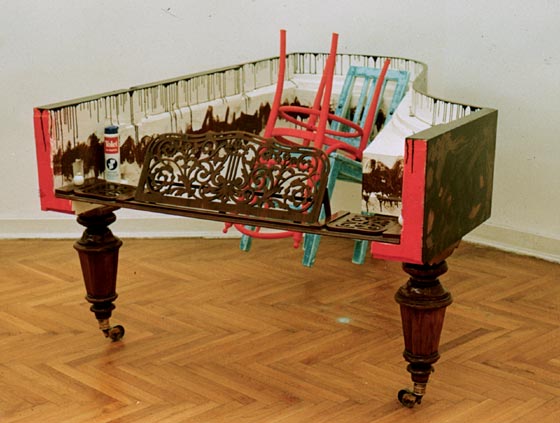
Piano of silence / Csendzongora
Composition for silent piano / Kompozició csendzongorára
“Can pure artistic space exist at all? Space where art enjoys protection? Perhaps inside an instrument? Sometimes we must reach the state of silence, when we can exterminate the cockroaches and refresh the air. We can clarify the ingoing things and clean the place for the outgoing ones. The «Piano of Silence» is a reference to a state of cleansing and to the moment before and after all acts of creation. It is likely that working for silence is creation itself: here, the «Piano of Silence». The work expresses itself.”
(1988)
“The space of the prepared piano is a magical node. It is finding peace and liberation in regard to the creator, the refunctioning third person. The inside of the piano painted white, the cleaning agents, and the chair «painted» with blue vitriol create the feeling of being disinfected. The bright red colour – on the chair turned upside down can be interpreted as the harnessed inner «fire» of the pianist – on the instrument, as his «flesh» cut through. The object originally varnished brown on the outside is made unpresentable by the calligraphic smudging with black, fluid bitumen applied onto the abraded surface. The brown colour is transcribed into the interior space to fully envelope the object and to contain the names of Endre Ady and John Cage.”
(2004, Gy.G.)
Jegyzet: „Egyáltalán létezhet még tiszta művészeti tér, ahol a művészet védettséget élvez? Talán egy hangszer belsejében? Időnként el kell jutnunk a csend állapotába, amikor kiírthatjuk a csótányokat és felfrissíthetjük a levegőt. Tisztázhatjuk a bemenő dolgokat és a kimenők helyét is megtisztíthatjuk. A «Csendzongora» utalás egyfajta tisztulás állapotra, a mindenfajta alkotás kezdeti és utáni mozzanatára. Lehetséges az is, hogy a csendért folytatott munka maga az alkotás: íme, a «Csend-zongora». A munka kifejezi magát.”
(1988)
„Az átalakított zongora tere egy mágikus csomópont, megnyugvás és felszabadulás az alkotó, az átfunkcionáló harmadik személy tekintetében. A zongorabelső fehérre festése, a tisztítószerek és a kék rézgáliccal «festett» szék a fertőtlenítettség érzetét kelti. A világító piros szín - a felfordított széken - a zongorista féken tartott belső «tűzeként», - a hangszeren - annak átmetszett «húsaként» értelmezhető. A külső felületén eredetileg barnára politúrozott tárgyat lecsiszolás és fekete, folyékony bitumennel kaligrafikus maszatolás teszi szalonképtelenné. A barna szín átíródik a belső térbe, hogy teljesen körül vegye a tárgyat és hogy magába rejtse Ady Endre és John Cage nevét.”
(2004, G.Gy.)